2. Developing models to study MS
MS (culture) models make it possible to better study and ultimately understand the disease. The development of these so-called MS models is therefore of great importance. They can provide insight into the various processes involved in MS, such as demyelination and remyelination, and also support the development of new treatment strategies.
Projects
The establishment of an MS patient–derived iPS cell biobank to develop MS lesion models in a culture system
RESEARCHERS – Hilmar van Weering, Wendy Oost, Sharon Brouwer, Wia Baron, Bart Eggen en Jan Meilof
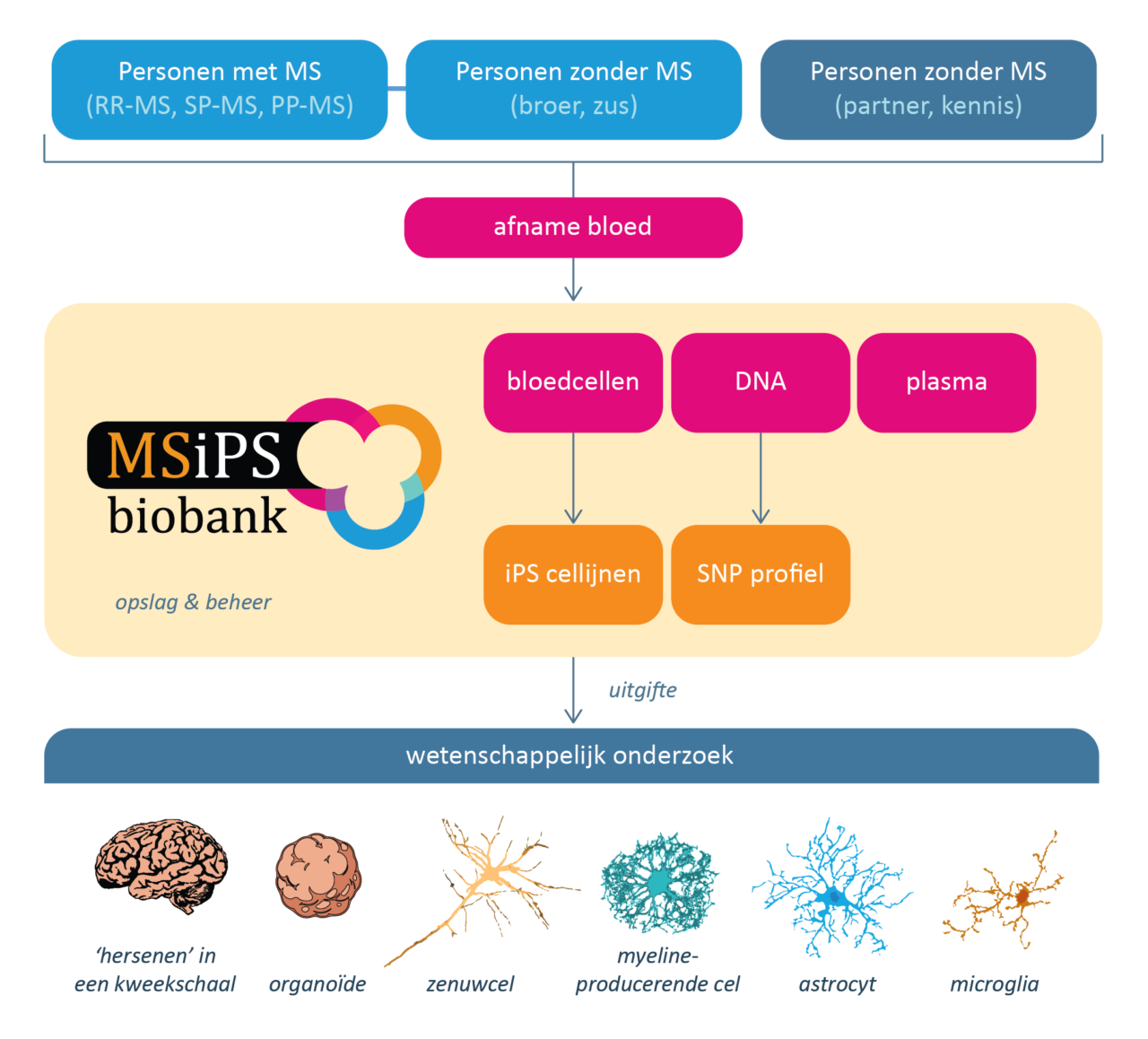
PROJECT: The effectiveness of currently available medications, particularly for progressive Multiple sclerosis (MS), is limited. This is partly due to the still unknown underlying mechanisms that drive the formation of MS lesions and disease progression. Studying the disease process in cells from people with MS will provide insight into cell-intrinsic processes that contribute to the disease.
Using the recently developed induced pluripotent stem (iPS) cell technology, we can reprogram blood cells into iPS cells. These iPS cells can then be differentiated into central nervous system cells and cultured in an MS-specific microenvironment to be used for modeling MS in a culture system. This groundbreaking approach is highly suitable for studying disease mechanisms and facilitating the screening of new therapeutic strategies.
In this project, funded by Stichting MS Research and made possible by the Vriendenloterij, we have established an iPS biobank derived from MS patients (MSiPS Biobank), consisting of a unique collection of well-characterized iPS cell lines from people with MS and relevant controls. This will significantly accelerate the development of new therapeutic approaches for (progressive) MS.
The MSiPS cell lines in this biobank can be requested by research groups worldwide. We hope that this facility will greatly advance MS research.
Financial contribution from Stichting MS Research (16-972) and thanks to participants of the Vriendenloterij
Strengthening the brain’s delta works
RESEARCHERS – Midas Anijs, Pauline van Schaik, Wia Baron, Elga de Vries en Bart Eggen
PROJECT: The blood-brain barrier (BBB) protects the brain from unwanted substances, but it also complicates the treatment of Multiple sclerosis (MS). In MS, the BBB is severely disrupted, contributing to inflammation, lesion formation, and disease progression. How this occurs is still unclear.
In this project, we map the BBB using brain tissue from people with and without MS and develop unique human culture models on a chip. With these models, we study the processes that disrupt the BBB and test strategies to strengthen or restore its function.
Expected results and impact: a human BBB model that can improve drug delivery, reduce the need for animal experiments, and provide new therapeutic targets to counteract brain inflammation and nerve damage in MS.
Financial contribution from Stichting MS Research (22-1162)
MS models in development
RESEARCHERS – Midas Anijs, Susanne Kooistra, Wia Baron, Bart Eggen en Jan Meilof
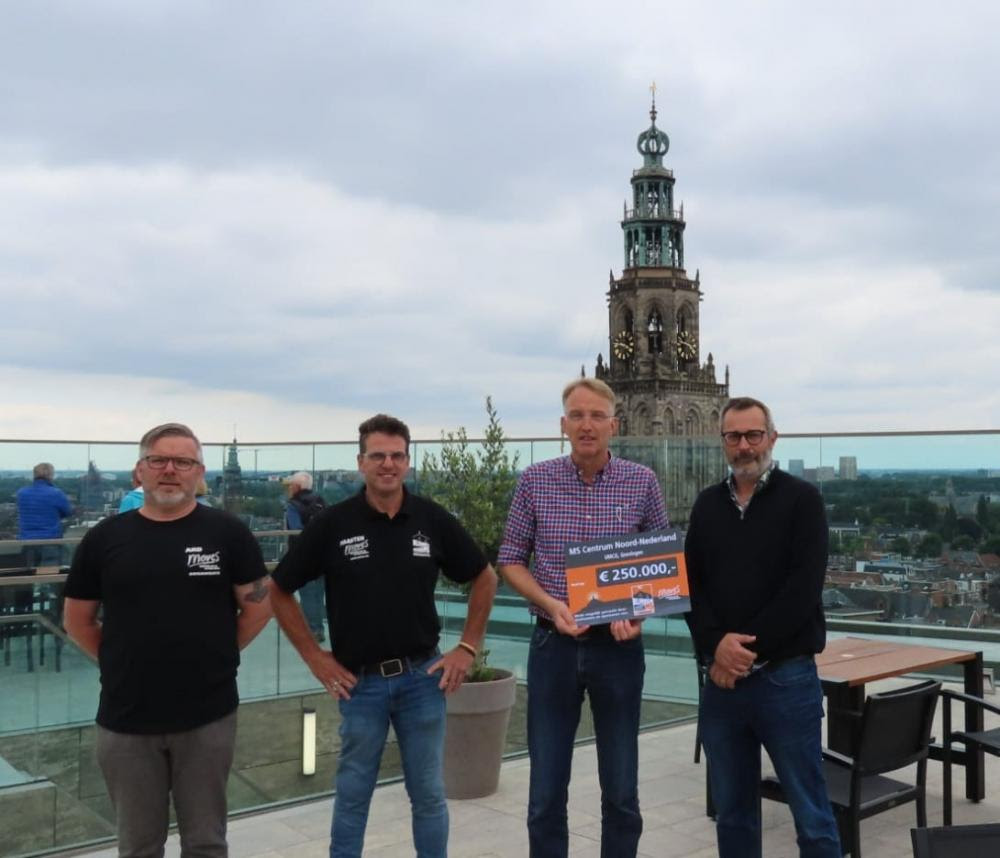
PROJECT: What exactly causes myelin breakdown in Multiple sclerosis (MS), and why does myelin repair sometimes fail after damage? The MS Centrum Noord Nederland will use this MoveS Inspiration Grant to address these questions. To do so, we will develop new preclinical MS models in which the processes of myelin breakdown and repair can be mimicked and studied.
One of these models is mini-brains, or organoids, created from cells of people with the various forms of MS. Organoids are small spherical cell clusters about 1–2 mm in diameter. They are composed of donor cells with the specific MS disease course, thereby retaining the same distinctive disease characteristics. With this model, we study the interactions between different cell types and the processes involved in myelin breakdown and repair.
The second model system is the “brain tissue in culture” model. In these brain tissue slices, we can selectively remove or modify certain cells, allowing us to mimic the damaged brain regions seen in people with MS and generate MS-specific tissue slices.
At the end of this project, we expect to have a unique and standardized collection of preclinical MS models that more accurately reflect the disease features and processes of MS before and after myelin damage.
Both models can be used to develop new treatment strategies for MS and to test candidate drugs. With these physiologically relevant preclinical MS models, we aim to take a major step forward in translating laboratory research to patients and bringing a world without MS closer.
This project is made possible by the MoveS Inspiration Grant.
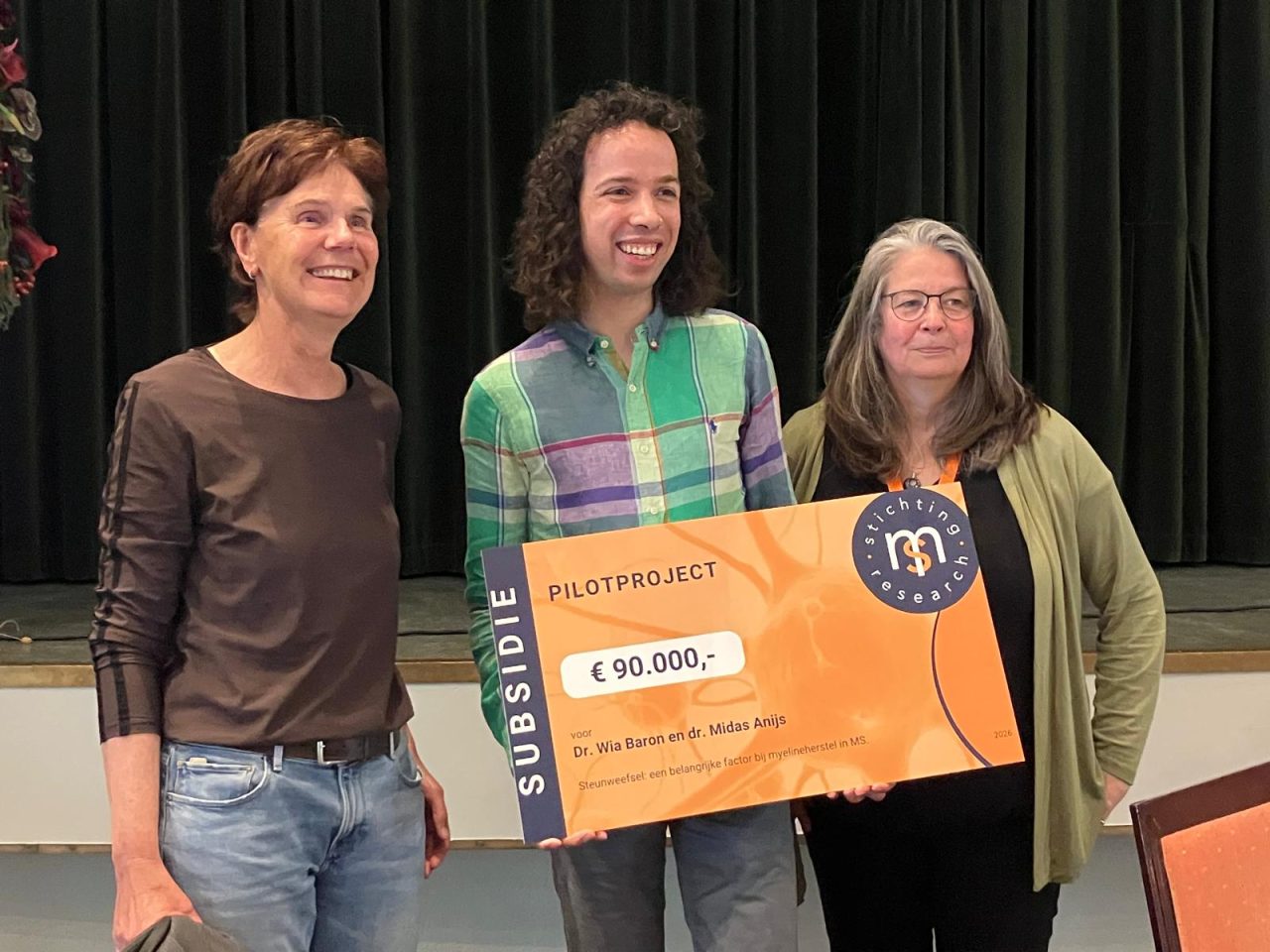
The extracellular matrix: and important factor in myelin repair
RESEARCHERS – Midas Anijs, Wia Baron
PROJECT: Some MS lesions recover, while others do not. Wia and Midas want to understand this difference by looking not only at the cells themselves, but also at their immediate environment.
Between the cells is the extracellular matrix, a network of molecules that plays an important role in communication between cells. When tissue is damaged, changes in the composition and stiffness of this matrix sends signals to the cells to regulate the repair process. Previous research has shown that the extracellular matrix differs between MS lesions, which may explain why myelin repair does not occur in some lesions.
Wia and Midas will create gels from the extracellular matrix of different MS lesions. This will allow them to map the differences between MS lesions and investigate how these changes affect the cells. This knowledge could lead to new targets for promoting myelin repair.
Financial contribution from the MS Research Foundation